


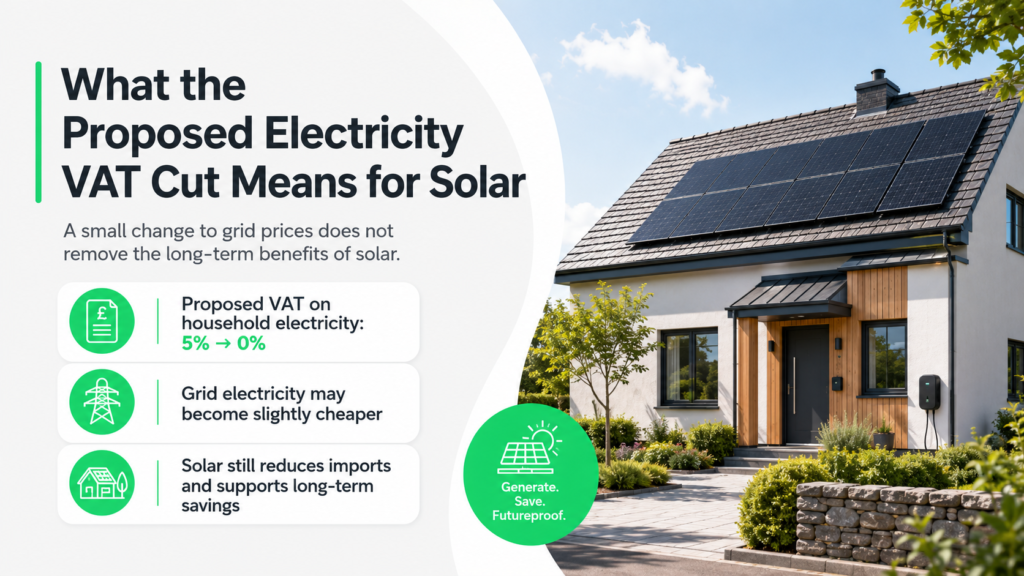
The Government has announced that VAT on domestic electricity bills will be reduced from 5% to 0% from 1 October 2026.
Understandably, some homeowners considering solar panels may be wondering whether cheaper grid electricity will make solar less worthwhile. However, while the announcement is welcome news for households, the effect on the financial case for solar is relatively small.
Solar panels will continue to reduce electricity bills, provide greater control over household energy costs and allow homeowners to benefit from the electricity generated by their own roof.
What has been announced?
The Government has confirmed that VAT will be removed from domestic electricity bills from 1 October 2026. It estimates that the change will reduce the annual Ofgem price cap by approximately £45 for a typical household. The measure is currently funded for the remainder of the financial year, with any longer-term action due to be considered at the Budget.
The reduction should apply to households on both variable and fixed electricity tariffs, with suppliers expected to pass the saving on to their customers.
This is positive news for energy consumers, but it is important to put the scale of the reduction into context.
How much cheaper will electricity become?
Removing 5% VAT does not mean electricity prices will fall by a significant amount. It only removes the tax currently included within the overall electricity rate.
For example, the average electricity rate under the Ofgem price cap between July and September 2026 is 26.11p per kWh, including VAT. Removing the VAT element would reduce this to approximately 24.87p per kWh, assuming the underlying electricity price remained unchanged.
That is a reduction of approximately 1.24p for every kWh imported from the grid.
It means that electricity generated and used from solar panels becomes slightly less valuable, but the vast majority of the saving remains.
As a simple illustration, if a solar installation was previously helping a household avoid £500 of imported electricity costs each year, removing the VAT element would reduce that part of the saving by around £24—not remove the £500 saving altogether.
Why solar is still worth considering
The main financial benefit of solar panels comes from reducing the amount of electricity you need to purchase from an energy supplier.
Every unit of solar electricity used within the home is still a unit that does not need to be bought from the grid.
Solar panels can continue to help homeowners:
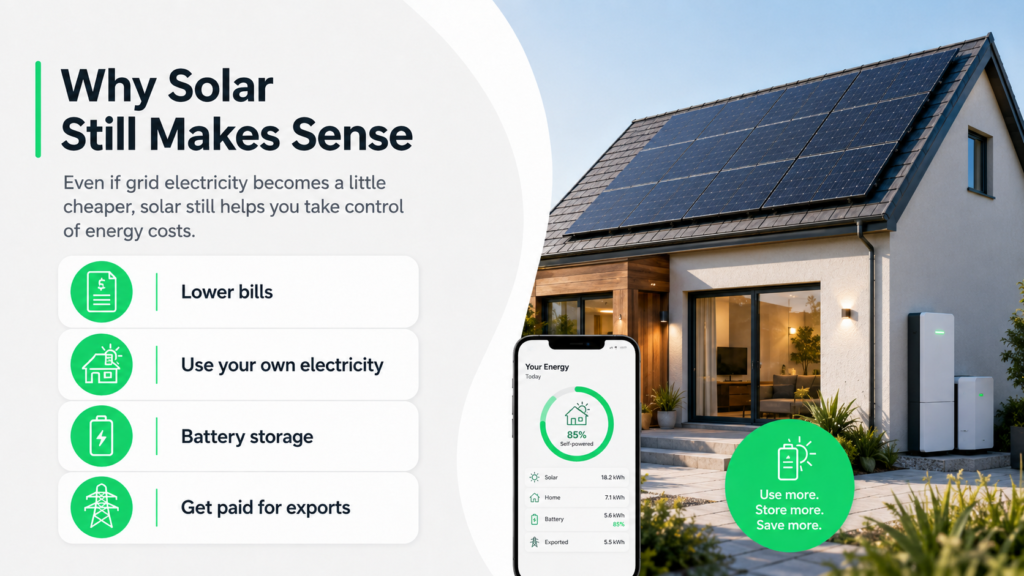
- Reduce their electricity imports
- Protect themselves against future energy-price increases
- Generate clean electricity for appliances, heating and EV charging
- Receive payments for surplus electricity exported to the grid
- Store excess generation in a battery for use later
The Energy Saving Trust confirms that solar panels can generate electricity even on cloudy days. Surplus electricity can either be stored in a battery or sold back to the grid.
The exact financial return will depend on the property, roof orientation, system size, electricity consumption and how much solar generation is used within the home.
Export payments are not affected
The VAT announcement relates to the price households pay when purchasing electricity. There has been no announced change to the Smart Export Guarantee as part of this policy.
Under the Smart Export Guarantee, participating electricity suppliers pay eligible small-scale generators for low-carbon electricity exported to the National Grid. Suppliers set their own rates and terms, so homeowners should compare the available export tariffs.
This means a solar installation can continue to provide value in two ways:
- By reducing the electricity purchased from the grid.
- By earning export payments for electricity that is not used within the property.
Export income is therefore separate from the reduction in VAT on imported electricity.
What about battery storage?
Battery storage can increase the amount of solar electricity used within the home.
Without a battery, surplus solar generation during the day may be exported to the grid. A battery can store some of this electricity so that it can be used later in the evening, when the solar panels are producing less or no electricity.
Batteries may also be used with certain time-of-use tariffs to charge when grid electricity is cheaper and reduce imports during more expensive periods.
The VAT reduction may slightly affect the value of battery savings from avoided imports, but it does not remove the benefits of storing solar generation, reducing peak-time imports and gaining more control over household energy use.
Solar and battery installations remain at 0% VAT
The VAT charged on an electricity bill is separate from the VAT treatment of installing solar panels and batteries.
Qualifying domestic solar panel installations currently remain zero-rated for VAT until 31 March 2027. Electrical storage batteries installed in residential accommodation—including eligible standalone battery installations—also qualify for the temporary zero rate. From 1 April 2027, the current guidance states that qualifying installations will return to the reduced VAT rate of 5%.
Therefore, the Government’s electricity-bill announcement does not increase the upfront VAT cost of installing a domestic solar or battery system.
Solar is a long-term investment
Electricity prices and Government policies will continue to change over the lifetime of a solar installation.
A decision to install solar should not be based solely on one temporary movement in electricity prices. A properly designed solar system can continue generating electricity for decades, reducing dependence on energy suppliers and helping households manage future price uncertainty.
The VAT reduction is expected to save the typical household around £45 per year. Solar panels, meanwhile, can continue producing thousands of units of electricity annually, depending on the system and property.
Although removing VAT from electricity bills slightly reduces the value of each solar-generated unit used within the home, it does not fundamentally change the case for solar.
The conclusion
The removal of VAT from domestic electricity bills is welcome support for households, but it does not make solar panels a poor investment.
Grid electricity will not become free. Households will still pay for every unit they import, while electricity generated and used from solar panels will continue to reduce those imports.
With potential bill savings, export payments, battery storage and protection against future energy-price increases, solar remains a practical long-term investment for suitable homes.
At Genfit, we assess each property individually and provide estimated generation, savings and payback information based on the proposed system and the customer’s electricity usage.
Considering solar for your home? Contact the Genfit team to arrange a tailored assessment and find out how much electricity your roof could generate.